 Stella Maris Samoyeds
HISTORY OF THE SAMOYED
The Origen & History of the Samoyed
An arctic working breed that has been living inside human families for a very long time. Here is the standard our dogs are judged against — and the part most websites leave out.
AKC breed standard
What judges are looking at.
Summarised in plain English. The full standard is published by the Samoyed Club of Americahttps://www.samoyedclubofamerica.org/the-samoyed/in-depth/breed-origin-and-history/
General appearance
The breed standard recommends males to stand between 21″-23.5″ inches at the shoulder; and females between 19"-21″. There is not a disqualification of size in this breed. Size can vary from 17 to 25 inches.
Coat
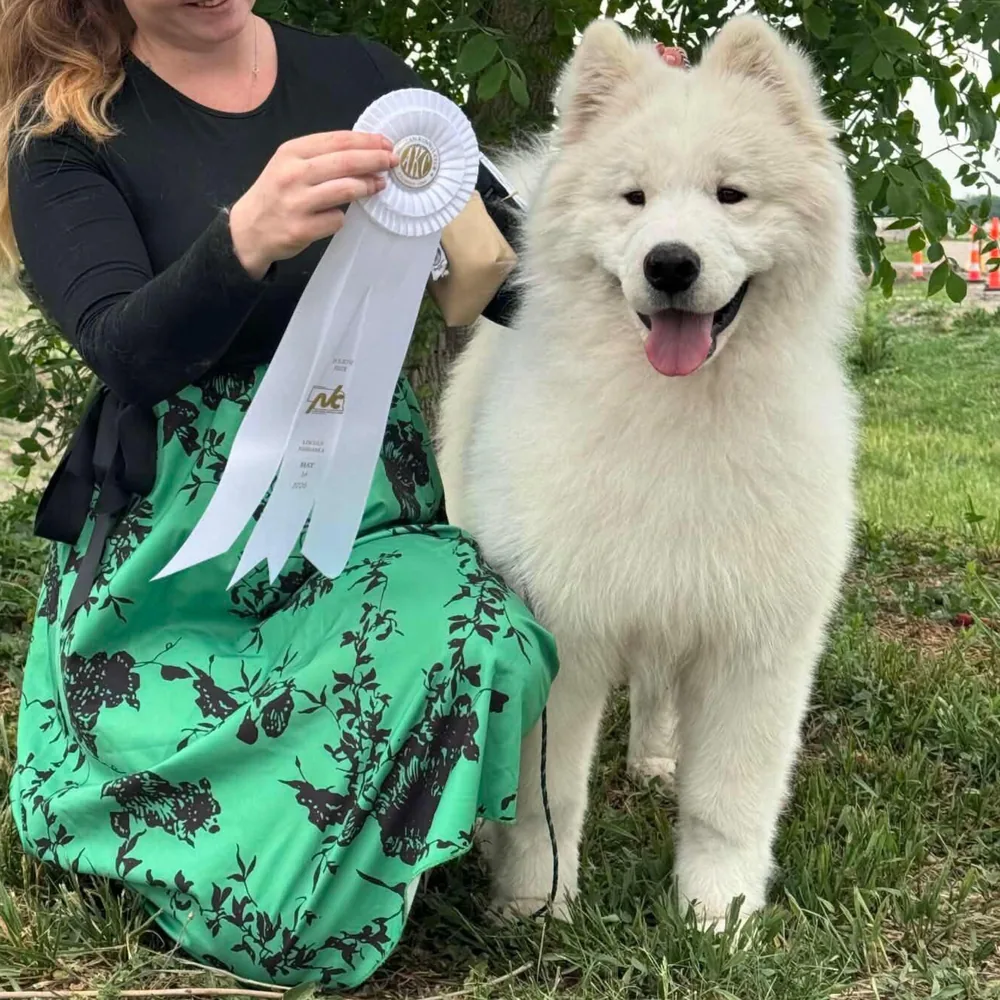
The Samoyed has a double coat, the undercoat being wool which when carded and spun can be woven or knitted into beautiful clothing. It is strong and warm. The coat is odorless, the outer coat is coarse, long and the tips have a silver glint. Both coats should stand out from the body — a drooping coat is not typical of the breed. The color is white, cream, or white with biscuit highlights. The wool is not sheared. Samoyeds shed. Females usually shed twice a year, male dogs once (though they can have a slight shed midseason). Once the Samoyed has had a complete shed and the new coat starts to grow in, there is no hair problem as with shorthaired breeds. However, when they do shed, there is a lot of hair around. In some areas where humidity is high, there can be more shedding problems. In summer, when the woolly undercoat is shed, the coarse outer coat seems to act as protection against the sun.
Expression
The “Samoyed smile” — the mouth curving slightly upward at the corners. Eyes dark, almond-shaped, set well apart and deep. Ears thick, erect, triangular and slightly rounded at the tip.
Tail
Moderately long, carried over the back or to one side when alert, and dropped when at rest. It should be mobile and loose, not tightly curled against the back.
Movement
Quick and agile, with a free, balanced, vigorous stride. Good reach in front and strong drive behind. A Samoyed that cannot move well is not a Samoyed doing its job.
Temperament
Intelligent, gentle, loyal, adaptable, alert, full of action, eager to serve. Friendly but conservative. Displays of unprovoked aggression or excessive shyness are serious faults.
The honest part
Five reasons this might not be your breed.
We would rather talk you out of a Samoyed now than take one back at eighteen months. Nothing below is a complaint — it is simply what the breed is.
The coat is a second job
Brushing several times a week, and twice a year they blow coat completely — clouds of it, for weeks. This is the single most common reason Samoyeds end up rehomed. If that sounds unbearable, believe yourself.
They are loud and opinionated
Samoyeds talk. Not just barking — grumbling, howling, arguing. Charming in a farmhouse, harder in a shared wall.
They were bred to work with people
They were bred to herd, haul and sleep among the family that fed them. A Samoyed left alone all day is a miserable, destructive, extremely vocal dog.
They will dig, and they will run
Prey drive and a sense of humour. A secure fence is not optional, and off-lead reliability is a project rather than a given.
They are not guard dogs
The standard calls for a friendly, conservative temperament. A Samoyed will tell you somebody is at the door and then try to leave with them.
And if it is your breed
There is nothing else like one.
They are funny, and they know they are funny. They are gentle with children in a way that has to be seen. They will follow you from room to room for fifteen years and consider it a job well done.
Everything above is the price of admission. Plenty of us pay it happily, twice over.